Most pool leak repair companies hand you a detection report and leave you to find a separate contractor. We detect with technical certainty and possess the full mechanical capacity to execute the repair immediately following the diagnostic phase. That means you can move from an identified problem to a repair in a single managed visit, with one point of contact and no scheduling gap between what was found and what gets fixed.
You still own the findings. Our diagnostic report belongs to you, and you’re free to take it to any third-party professional if you choose. Our Know Before You Go pricing approach means you receive honest, upfront pricing before any work begins, so there are no surprises when the job is done. For homeowners filing through insurance, we’re pre-approved with top insurers, which can support faster claims coordination. Financing is also available for pool leak repair services when you need flexibility.
We also provide Pool Leak Detection, Leak Detection, Leak Repair, Slab Leak Detection, and Infrared Leak Detection to help keep your entire water system secure.
Common Hydraulic Failures in Bakersfield Pools
Pool systems in neighborhoods like Seven Oaks and Kern City include multiple penetration points where leaks develop as materials age and Central Valley ground movement compromises seals. Kern County’s dry, shifting soil places lateral pressure on rigid PVC plumbing lines buried beneath pool decks, forcing joints to flex over time. Here’s where failures most often originate:
- Shell and Fitting Breaches: Water escapes through gaps around underwater lights, main drains, or the tile line. The expansion-contraction cycle driven by Bakersfield’s temperature swings breaks watertight seals between concrete and plastic skimmer housings, eventually producing hairline fractures in the spa spillway or skimmer throat.
- Underground Plumbing Failures: Suction lines and return lines under constant pressure can develop failed joints or cracked PVC pipes several feet underground. Because the loss never appears as a surface puddle, homeowners often attribute significant water loss to evaporation before the breach is identified.
- Equipment Pad Malfunctions: Pump seals, heater connections, and multi-port valves develop drips that can force the motor to work harder, shortening equipment life and increasing energy consumption across the system.
How We Find & Fix Pool Leaks
A targeted repair is only possible after a rigorous diagnostic phase. Our technicians use acoustic listening devices to hear the exact location of escaping water, pressure testing to confirm the integrity of buried plumbing lines, and specialized underwater dyes to visualize structural voids in the shell. Guessing at the failure location and digging to find it is a common cause of unnecessary deck demolition and inflated repair costs. We don’t operate that way.
Once the exact failure coordinate is confirmed, access is limited to the minimum footprint required. Structural repairs use industry-leading underwater epoxies or masonry work to seal skimmer throats and light niches. Where possible, in-water repairs keep the pool full throughout the process, avoiding the risk of shell lift or further cracking that an empty pool can carry in shifting Central Valley soil. Plumbing repairs expose only the specific section of pipe that has failed. After the repair is complete, we pressure-test the system a second time to confirm the hydraulic loop is fully sealed.
Ready to stop refilling and start swimming? Call American Leak Detection of Bakersfield at (661) 426-2405 to speak with our local team and request a service call for your pool leak repair in Bakersfield.
Frequently Asked Questions
How Do I Know If My Pool Is Leaking or Just Evaporating in the Kern County Heat?
Try a bucket test: fill a bucket with pool water, set it on a pool step, and mark both the water level inside the bucket and the pool level on the wall. After 24 hours, compare the two drops. If the pool drops noticeably more than the bucket, that can signal a mechanical breach. Normal summer evaporation affects both equally.
Will Fixing a Plumbing Leak Mean Tearing up My Entire Concrete Deck?
No. Acoustic listening devices and hydraulic pressure testing let us isolate the failure within a small radius before any digging begins. That precision allows a localized repair or pipe bypass that leaves the majority of your decking intact. Trial-and-error excavation is what creates large demolition footprints; we eliminate that step from our process.
Can a Pool Light Niche Leak Throw off My Water Chemistry?
Yes. Any breach that triggers the auto-filler to run continuously dilutes chlorine, salt, and pH levels with fresh water. If you’re adding chemicals more frequently than usual just to hold water clarity, a failed structural seal such as a cracked light niche or skimmer throat may be the cause. Pool water chemistry dilution from a hidden leak can accelerate equipment corrosion as well.
Is It Safe to Run My Pool Pump If I Think There’s an Underground Leak?
It depends on where the leak is. A suction-side leak pulls air into the pump, risking overheating or loss of prime. A return-side leak pushes treated water into the ground under pressure, accelerating soil erosion beneath the deck. We recommend a professional evaluation before deciding whether to keep the system running so you don’t compound the existing damage.
Do You Offer Financing for Pool Leak Repairs?
Yes. Financing is available for pool leak repair services. Contact our Bakersfield team for details on what options are available for your project.



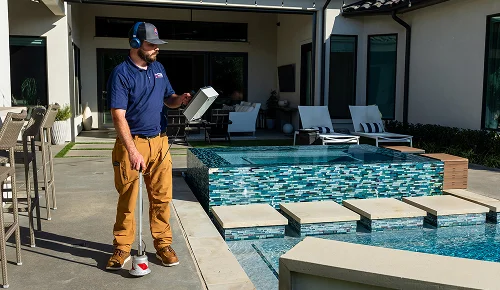 For 50+ years, we’ve developed tools to make leak detection faster and less disruptive.
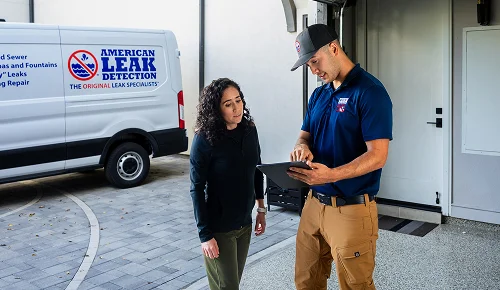 Learn all your options with pros, cons, and costs before making any decisions.
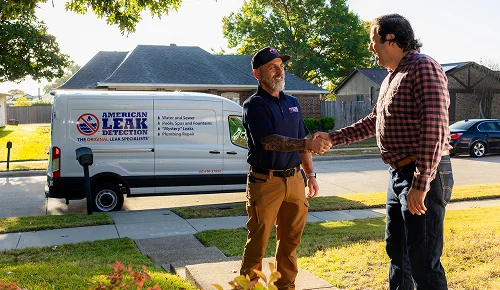 Pre-approved with top insurers means faster claims and smoother coverage.
 Trained specialists who detect leaks in every system, from pools to commercial pipes.


